Why you keep falling back into a habit you want to stop, and how to catch the moment before it
By Tristan6 min read
- bad habits
- habit triggers
- relapse
- self-awareness
On this page 7
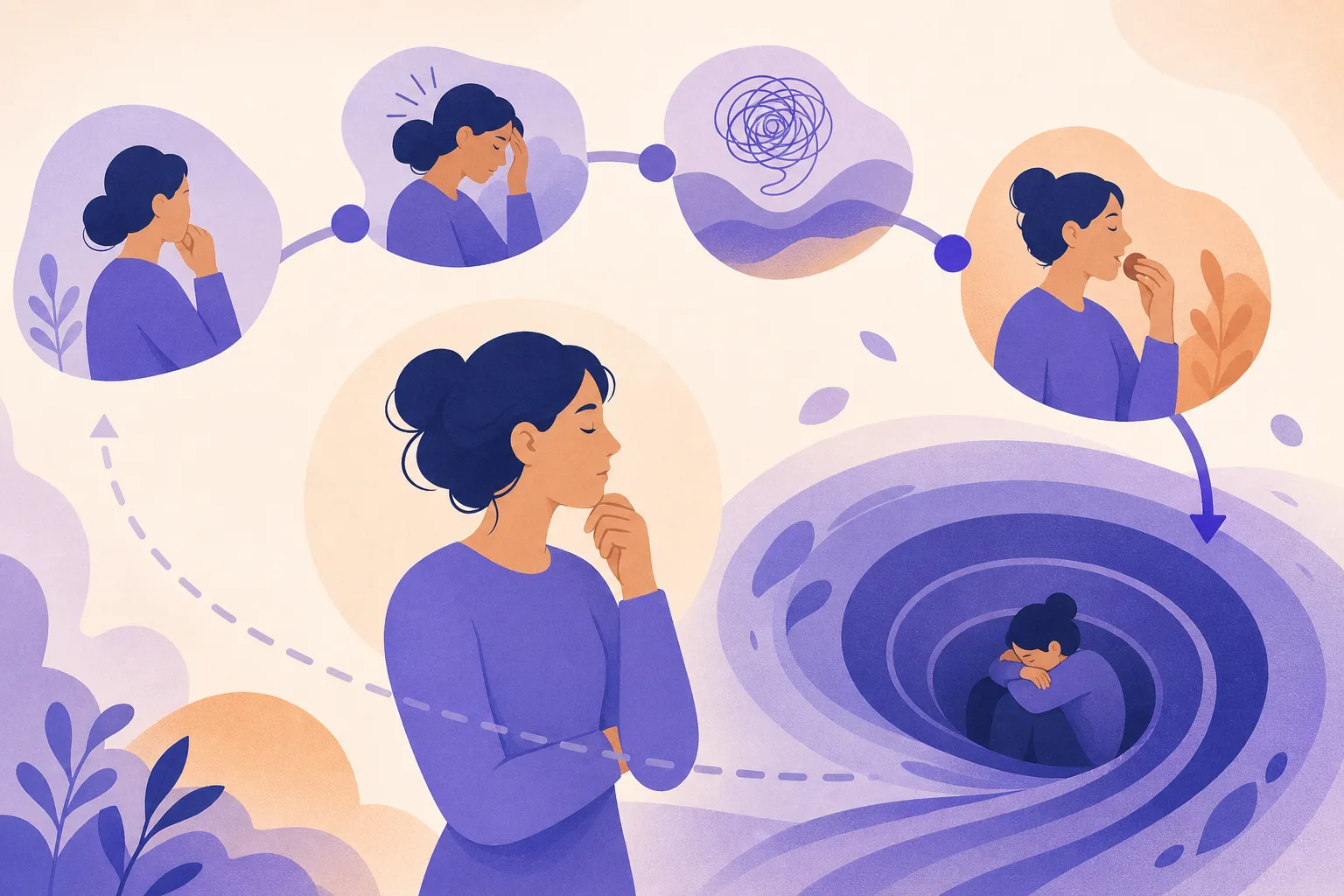
You keep falling back into a habit because it still does a job for you, like calming you down, filling a gap, numbing a feeling or giving you a break, and the moment that sets it off passes before you notice it. Willpower is aimed at the habit itself, but the habit starts earlier, in a feeling, a time of day, a place or a thought. If you learn to spot that earlier moment, you get a few seconds where you can still choose, and over time you can see which moments keep coming back.
Why the moment before is so hard to see
From the inside, a relapse feels sudden. One minute you were fine, the next you were already scrolling, eating, smoking, snapping or opening the tab. That's because a well-worn habit runs mostly on autopilot: the trigger and the start of the behavior are glued together, and your attention only switches on once you're halfway through.
A few things make it harder still:
- The trigger is often a feeling you didn't name. Boredom, mild loneliness, shame after an email, or restlessness at 10 pm rarely announce themselves. You notice the urge, not the feeling underneath it.
- Memory rewrites it afterwards. Looking back, you tend to remember the slip and the guilt, not the twenty minutes before it.
- Each slip looks like a one-off. "I was just tired." "It was a weird day." Every reason sounds true on its own. The pattern only shows up when you put several slips side by side.
- Guilt shuts down curiosity. If every slip ends in self-criticism, you'd rather not look closely, and the trigger stays hidden.
What usually sits right before a slip
The thing before a habit tends to fall into a handful of categories. Knowing them gives you something specific to look for instead of a vague "why did I do that again?"
| What to look for | Questions to ask yourself | Example |
|---|---|---|
| Feeling | What was I feeling just before the urge? | Bored, anxious, rejected, flat |
| Body state | Was I tired, hungry, wired, in pain? | Skipped lunch, slept badly |
| Time | When did it happen? | Right after work, late at night |
| Place | Where was I? | Bed, car, kitchen, desk |
| People | Who was around, or who had I just dealt with? | After a call with a parent, alone all evening |
| Thought | What was I telling myself? | "I deserve this", "Today's ruined anyway" |
| Just before | What was I doing a minute earlier? | Closed a hard task, opened my phone |
The last row matters most. Often the real trigger is a transition: finishing something, avoiding something, or a gap with nothing planned.
How to catch the moment before, starting today
- Pick one habit, not five. Write down in plain words what counts as a slip, so there's no arguing with yourself later.
- After each slip, rewind 30 minutes. As soon as you can, without judging yourself, note the time, place, who was around, what you felt, what your body felt like, and the thought that came right before. A few words per line is enough.
- Log the urges you resist too. Moments where you wanted to but didn't are just as useful. They show what's different when you hold off.
- Name the job the habit did. Finish the sentence: "In that moment, it gave me…" Relief, a break, company, a sense of control, not having to start something.
- After a week or two, read everything at once. Look for repeats: the same hour, the same room, the same feeling, the same phrase in your head. Two or three repeats are a lead worth following.
- Write one if–then plan for your most common trigger. Make it specific: "If I get home and feel flat, then I make tea and text one person before I sit on the couch." The new action should do the same job the habit was doing, otherwise the urge will win.
- Add friction at that exact moment. Put the phone in another room at 10 pm, don't keep it in the house, log out, move the chair. Make the habit slightly harder right where the pattern says it starts.
A note after a slip might look like this:
Tuesday, 9:40 pm, bed. Ate the whole bag again. Before that: answered a work message I'd been dreading, felt annoyed and a bit stupid. Thought: "I can't deal with anything else today." It gave me: a way to switch off.
One note like that says little. Five notes that all mention evening, bed and a hard message say a lot.
Why noticing over time works when willpower doesn't
Willpower asks you to win the fight once the urge is already strong. Noticing patterns moves the fight earlier, to a point where the pull is weaker and you have more options. It also changes the question from "what's wrong with me?" to "what keeps happening before this?", which is a question you can actually answer.
Patterns also show you what to change around the habit, not just the habit itself. If most slips follow skipped meals, the fix might be lunch. If they follow contact with one particular person, the work might be on that relationship or on how you recover after it.
You can keep these notes in a paper notebook or your phone's notes. If you'd rather not have to read through everything yourself, undrstand is one way to collect them: you can do a quick check-in, talk it out loud, answer one question a day or photograph a journal page, and it looks across what you've shared to show the triggers and recurring thoughts that keep showing up before a habit. You can also describe a small app of your own inside it, like an evening check-in that asks whether you felt the urge today and what was going on just before.
When a slip is just a slip
Falling back once doesn't erase the progress you've made, and it doesn't prove you can't change. The most damaging thought after a slip is usually "I've blown it, so I might as well keep going." Treat each slip as information: write down what happened before, adjust the plan, and start again with the next choice, not next Monday.
When to get more help
If the habit involves alcohol, drugs, gambling, self-harm, disordered eating or anything that's hurting your health, money or relationships, or if you've tried for a long time and keep losing ground, talk to a doctor, therapist or a specialist support service. That isn't a failure of self-awareness. Some habits are tied to dependence or deeper distress, and noticing patterns on your own is not a replacement for professional care. If you ever feel unsafe, contact local emergency services or a crisis line right away.